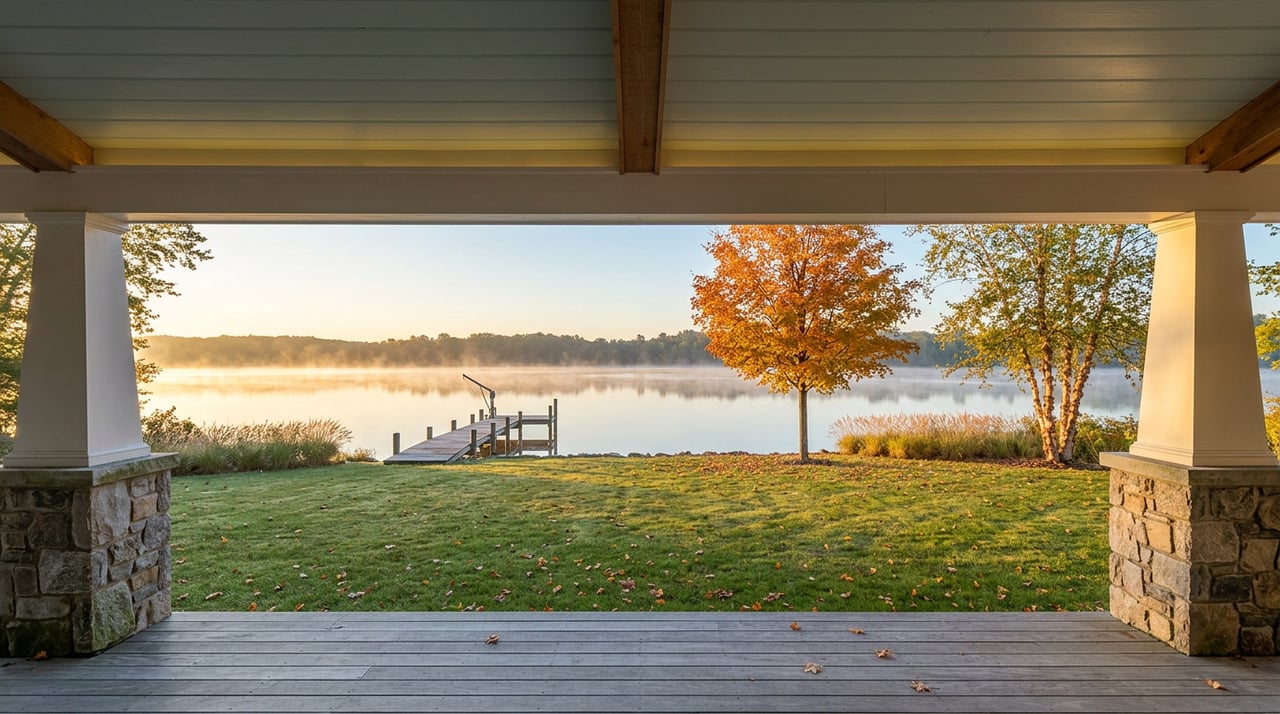
Two houses on the same block, both listed with "Lake Minnetonka frontage" in the headline, can hand their new owners two completely different sets of rights. One comes with a private dock you can rebuild, extend in a dry year, and pass down with the deed. The other comes with a water view, a shared easement, and a waiting list. The listing photos rarely tell you which one you're buying. The paperwork does, and most buyers never ask to see it before they write an offer.
That gap between what a property looks like and what it legally entitles you to do is the single most expensive blind spot on this lake.
The Three Tiers Hiding Behind One Word
Real estate listings tend to use "lakefront," "lake access," and "waterfront" as if they're interchangeable. On Lake Minnetonka they are not. Depending on the parcel, what you actually get falls into one of three categories.
- True riparian frontage. Your property line meets the water. You hold the right to apply for a private dock under Lake Minnetonka Conservation District rules, subject to setbacks and water depth. This is the tier most buyers picture when they search for a lake home, and it commands the premium.
- Deeded or shared access. You don't own frontage outright, but an association, subdivision, or city does, and that entity licenses dock space to member properties. The City of Minnetonka Beach runs one of the clearest examples of this on the lake: roughly 80 slips spread across the city under a single LMCD multiple dock license, with six priority levels and a waiting list for residents who want in. You get water access, but you don't control it the way a riparian owner does.
- Non-riparian or lake-adjacent. The listing might say "steps to the lake" or "lake view." You get the scenery and the neighborhood, not a legal claim to build anything into the water.
The distinction matters because Minnesota courts have been clear on a point that surprises a lot of new lake buyers: an easement that lets you walk to the water does not automatically give you the right to put a dock in it. Unless the easement specifically spells out riparian rights, access and dock rights are two separate legal questions, and a seller's verbal assurance that "we've always kept a boat here" is not the same as a recorded right that survives the closing.
Why the Water Level Changes What You're Actually Buying
The LMCD sets 929.4 feet as Lake Minnetonka's ordinary high water level, the benchmark everything else gets measured against. As of August 12, 2026, the lake sat at 928.75 feet, with the Minnesota DNR's HydroClim report noting that Gray's Bay Dam has been releasing water at 12 cubic feet per second most of the summer. That reading sits close enough to the lake's low water threshold that it's worth understanding what happens if the level keeps dropping.
| Elevation | What it means |
|---|---|
| 929.4 ft | Ordinary High Water level, the lake's legal baseline |
| 928.75 ft | Where the lake sat on August 12, 2026 |
| 928.6 ft | Level at which a Low Water Declaration automatically lifts |
| 928.0 ft | Threshold below which the LMCD Board may declare low water |
| 921.78 ft | Record low, set in 1937 |
| 931.11 ft | Record high, set in 2014 |
Once the LMCD declares low water, the rules for what you can do at your own dock change. Residential docks that meet certain conditions can extend 30 feet beyond the normal Dock Use Area at 928.0 feet, and up to 60 feet at 927.0 feet, without a separate permit, as long as depth stays under five feet and the property has no history of past variances. That last condition is the one buyers skip. If a previous owner ever sought a variance on that dock, the extension option may not be available to you at all, and you won't find that out from a walkthrough. It shows up in the LMCD's permit file for the parcel.
A dock that looks perfectly fine in a June showing photo can be sitting in ankle-deep water by September. Depth off the end of the dock, not depth at the shoreline, is the number to ask about, and it changes by bay and by season.
The Permit History Nobody Brings Up at the Showing
Most single-family docks on Lake Minnetonka don't need an annual permit. Where things get complicated is everything adjacent to that baseline case. A property needs a license to store five or more watercraft, and eligibility for that license often depends on shoreline footage, such as owning or sharing at least 226 feet of frontage at the OHW level, or being part of a homeowners association with a shared dock arrangement. Nonconforming docks and moorings have required permits since May 3, 1978, which means "grandfathered" is a real legal status here, but only if the dock predates that date and the paperwork exists to prove it.
The DNR's own guidance sets the baseline for docks statewide: no permit is needed if the dock is no wider than 8 feet, isn't combined with other structures into something larger, and doesn't block the free flow of water. The LMCD layers its own Dock Use Area rules on top of that, defined by setbacks from extended side property lines and how far the dock projects into the lake. Those setbacks are why two neighboring docks can look identical and still be governed by different rules.
Sometimes the paperwork is still being written when the house hits the market. A dock variance request at a Tonka Bay property on Lakeview Avenue sat under review by the LMCD, the applicant, and the city for two years, centered on a platform that exceeded standard size limits and a setback reduction from 15 feet down to 12.5 feet. If you're touring a home with an unusual dock configuration, a canopy, a platform bigger than 8 feet in both directions, ask whether it's fully permitted or whether it's part of an open variance file. The Minnehaha Creek Watershed District, for what it's worth, doesn't touch dock permits at all. That authority sits entirely with the LMCD, so if you call the wrong agency you'll get an answer that sounds authoritative and isn't.
What Changed on the Lake for 2026
Regulations here aren't static, and a buyer inheriting a property inherits whatever the LMCD has passed most recently, not just what was on the books when the seller bought in. The LMCD's rule requiring boats to stay 300 feet from shoreline and 150 feet from docks, anchored boats, and swimmers has been in place since 2023, but the LMCD confirmed to the Shorewood City Council in May 2026 that it has now added a 5 mph speed limit inside that same 300-foot buffer, enforced alongside the Hennepin County Sheriff's Water Patrol. Rental watercraft licensing enforcement has also tightened this year, with more operators coming into compliance after flying under the radar in prior seasons. None of this changes who owns what. It does change the day-to-day experience of using a dock near a busy channel or a rental-heavy bay, which is exactly the kind of detail that separates a lake home you love from one you tolerate.
Reading the Bays Like Someone Who Lives Here
Price per foot of frontage varies as much by bay as it does by house. Wayzata Bay and Browns Bay carry some of the highest demand on the lake, largely because they're walkable to downtown Wayzata's restaurants and shops. On the south shore, Excelsior's Water Street has spent the past two years turning into what the Star Tribune described as a suburban restaurant row, with a wave of new openings from established Minneapolis restaurateurs landing within steps of each other. That kind of walkable amenity base shows up in what buyers are willing to pay for proximity, separate from what the dock itself is worth.
Orono and Medina, on the west and northwest shores, trade that density for privacy: larger lots, more natural shoreline, a longer drive into Minneapolis. Mound and Spring Park have historically carried a more suburban, budget-conscious character, with older cottages that get bought as remodel or teardown candidates. None of these differences show up in a citywide median price. They show up when you compare two listings bay by bay, which is the only way pricing on this lake actually makes sense.
The Diligence List Before You Write an Offer
- Request the recorded easement or deed language covering water access, and confirm in writing whether it conveys dock rights specifically.
- Ask the LMCD directly whether the parcel has any permit history, variances, or open review files tied to its dock.
- Check actual water depth off the end of the dock, not at the shoreline, and ask how that depth has moved over the past several seasons.
- Confirm the dock sits inside its assigned Dock Use Area rather than encroaching on a neighbor's extended setback.
- Verify whether a dock, lift, or boathouse is transferable at closing or tied personally to the current owner.
- Order a lake-specific inspection that covers the shoreline, retaining walls or riprap, and the dock and lift systems, not just the house.
- Confirm whether the property is on municipal sewer or relies on a well and septic system that will need its own inspection.
A Few Questions Worth Asking Before You Fall for the View
Does living near Lake Minnetonka guarantee dock rights? No. Proximity and even a recorded easement to reach the water are not the same as riparian rights. Unless the easement specifically states that dock rights convey, you may have a beautiful walk to the lake and nothing to tie a boat to.
What happens to my dock if the LMCD declares low water while I own the home? You may be eligible to extend your dock without a separate permit, but only if your property has no history of prior variances and the extension meets the LMCD's depth and safety conditions. That history is exactly why the permit file matters before you close, not after.
Can dock rights be sold or transferred separately from the house? In some association and shared-dock arrangements, yes, access rights are tied to membership or a license rather than to the deed itself. In true riparian situations, the right typically runs with the land, but transferability of the physical dock or lift should still be confirmed in writing.
A house on this lake is never just a house. It's a set of rights, a permit history, and a relationship with a body of water that moves by the season. Sorting out which tier of access you're actually buying, before you're emotionally attached to a sunset view, is the difference between owning the lake life you pictured and owning a legal question mark with a dock attached.
If you're comparing Lake Minnetonka properties and want someone who will pull the LMCD file before you write the offer, not after, Tonia Kurth and the BOOST Real Estate Group can walk the shoreline with you. Schedule a Real Estate Strategy Call and get a clear read on what a specific property actually conveys before you commit to it.